An AI agent is software that receives a goal, decides the steps needed to reach it, uses tools and data to carry them out and checks the result, within the permissions someone has given it. A chatbot answers. An agent acts.
That difference matters more than any feature list, because it decides whether AI saves your team time or just produces text that someone still has to act on. For the business side, including what agents do inside a management system, see AI agents for business.
This guide stays general: what an agent is, how it compares with a chatbot and a classic automation, what it can execute, examples by area and what it needs to work.
A clear explanation of AI agents for people who run or work in a company, not for developers. Reading time: 8 minutes.
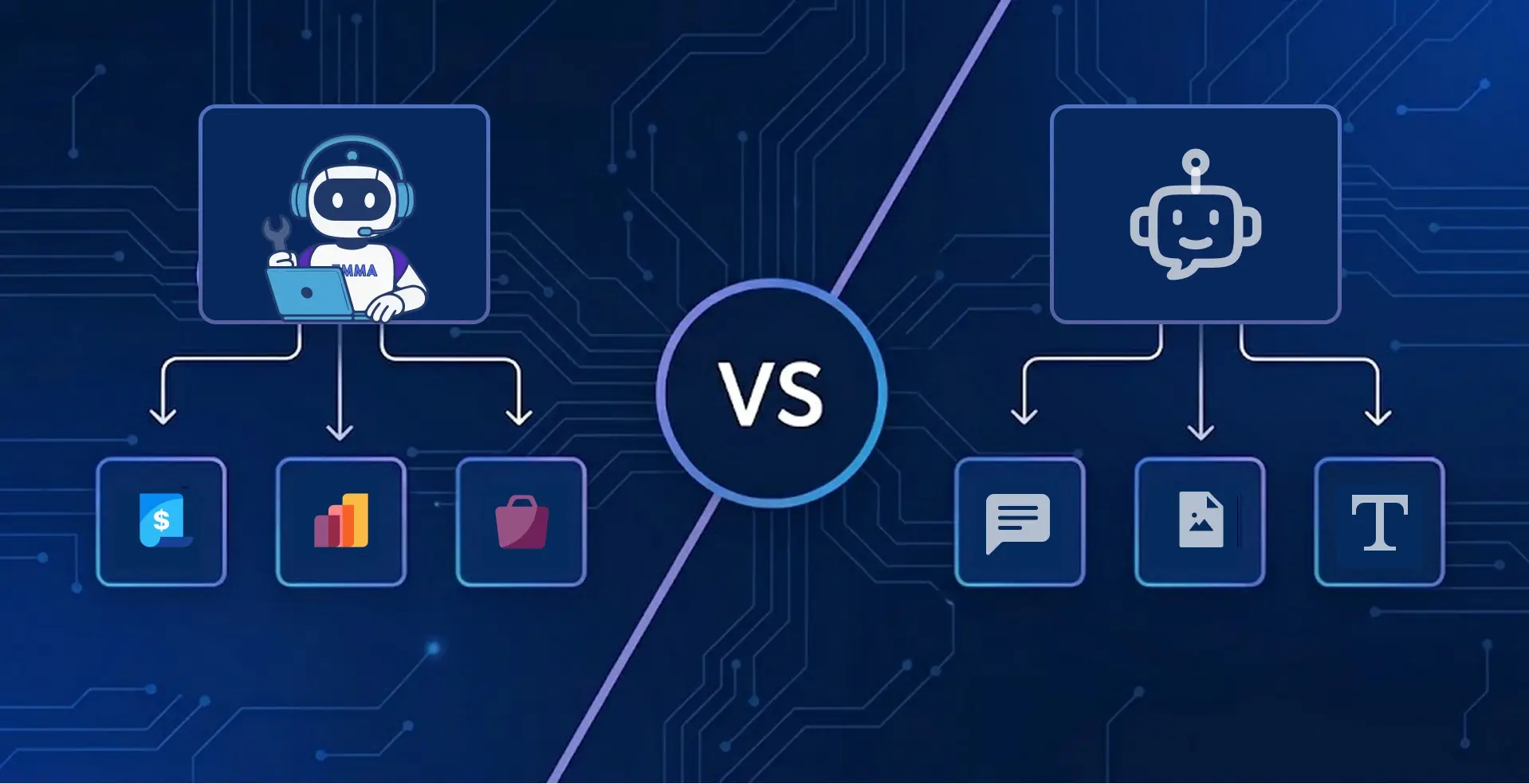
Chatbot, assistant and agent: comparison
Chatbot: answers questions, usually within the conversation. A person acts on the answer.
AI assistant: finds information and prepares drafts; available tools vary. A person guides and reviews the work.
AI agent: pursues a goal across several steps, chooses permitted actions and checks results. Its activity is controlled through permissions, approval points and logs.
In this article:
01 What is an AI agent
Strip away the marketing and an AI agent has four parts:
- A goal. Not a single question, but an outcome: "send a reminder for every invoice more than 30 days overdue".
- A model that reasons. Usually a large language model that breaks the goal into steps and decides what to do next.
- Tools. The actions it is allowed to take: search records, create a draft, send a message, call another system.
- Context and memory. The data it can read and what it has already done, so each step builds on the last one.
Those parts run in a loop. The agent looks at the situation, decides the next step, acts, checks what happened and repeats until the goal is met, or until it reaches something it shouldn't decide alone. That loop is the idea behind what agentic AI means: systems that pursue a goal instead of answering a single prompt.
Two things follow from the definition. First, an agent is only as capable as the tools and data it can reach: a brilliant model with no access to your records can't check a single invoice. Second, because it acts, it needs limits: what it can read, what it can change and when a person must approve.

02 What is the difference between an AI agent and an AI assistant?
An AI assistant helps a person complete work, usually by answering questions, finding information or preparing drafts. An AI agent can also choose and execute several steps toward a goal, using the tools and permissions it has been given. The distinction is the level of delegated action, not the quality of the conversation. Both need reliable data and human oversight; the name alone does not prove what a product can do.
The three get mixed up because they can look alike from the outside: someone types or something happens, and a result appears. The difference is who decides the steps and what the system is allowed to do.
| AI agent
|
Chatbot
|
Classic automation
|
|
|---|---|---|---|
|
What starts it
|
A goal, an event or a request | A question in a chat | A fixed trigger: "when X happens" |
|
Who decides the steps
|
The agent, within its rules | Nobody: it replies and stops | Whoever built the flow, in advance |
|
What it works with
|
Live data and the tools it can access | Its training, a script or an FAQ | The apps connected to the flow |
|
What it can change
|
Records, drafts and messages, within permissions | Nothing outside the conversation | Exactly what the flow defines |
|
When something unexpected happens
|
Adapts, or stops and asks a person | Gives a generic or wrong answer | Fails, or does the wrong thing silently |
|
Best for
|
Multi-step work that varies from case to case | Answering questions and guiding people | Identical, high-volume, predictable tasks |
One request, three systems. A customer writes: "Can you change the delivery address on my order?"
- Chatbot: explains how to change an address and links to the account page. The customer still does the work, and nobody checks whether the order has shipped.
- Classic automation: a form updates the address field on the order. It works until the parcel has already left the warehouse, and then it quietly updates a record that no longer matters.
- AI agent: checks the order status. If it hasn't shipped, it updates the address, confirms with the customer and logs the change. If it has, it tells the customer and passes the case to a person with the context.
None of the three wins in every case. A classic automation is cheaper and more predictable for identical tasks, and a chatbot is enough when people only need answers. An agent earns its place when the right next step depends on the data. Virtual assistants sit somewhere in between: they help a person with information and drafts, but usually don't execute on their own. See how a virtual assistant compares in real use cases.
Is ChatGPT an AI agent?
ChatGPT can work as a conversational assistant or use agentic capabilities to carry out multi-step tasks with tools. The product name alone does not tell you whether a given interaction is agentic. Ask what it is allowed to access, whether it can take actions and which decisions require approval. A text answer about your ERP is different from an authorised workflow that reads its records, acts and checks the result.
What types of AI agents are there?
AI agents can be grouped by how they choose actions: reactive agents respond to the current situation; deliberative agents reason about possible steps; goal-based agents work toward a defined outcome; utility-based agents weigh alternatives against a preference or score; and learning agents improve their behaviour through experience. These categories can overlap. For a company, the practical questions remain the same: what data the agent can read, which actions it may take and when a person must intervene.
Operational agents inside business software
An operational agent works with business records and the actions made available by the management system. For example, it may check an order and prepare the next step, rather than just describe the procedure. Its useful scope depends on the connected data, permissions and approval rules. Being inside an ERP does not remove the need for supervision.
How much does an AI agent cost?
There is no single price for an AI agent. Total cost combines the software licence, usage of the model or AI credits, and the work needed to connect data, configure permissions and test the workflow. Ongoing monitoring and maintenance also count. A free plan may be enough to try a limited task, but it does not establish the cost of running that task at your company’s volume. Compare the same workload and include human review.
What you pay for: licence, credits and setup
Licence: access to the platform and the features included in the chosen plan. Credits or usage: the model calls and actions consumed by the workflow; the unit and allowance depend on the provider. Setup: connecting authorised data, defining permissions and testing representative cases. Review the limits and ongoing support separately so a low entry price is not mistaken for the total operating cost.
03 What is an AI agent used for in a business
"Execute" is the word that separates agents from the rest, so it's worth being concrete. With the right access, an agent can:
- Read and search: find records, compare documents, check a status, pull the history of a customer or a supplier.
- Create and update: draft an invoice, a quote or a purchase order, fill in missing fields, correct a record.
- Communicate: write and send a reply, a reminder or an internal alert, in the tone and channel it has been given.
- Coordinate: take the result of one step and start the next, across several apps or systems.
- Report: summarise what it did, what it couldn't do and why.
What it shouldn't do alone
Being able to act doesn't mean it should act on everything. Sensible setups keep a person in the loop for:
- Payments, refunds and anything else that moves money.
- Legal, tax or contractual decisions.
- Messages with commercial or reputational impact.
- Changes that are hard to undo, such as deleting records.
Agents also have limits that no configuration removes. They can be confidently wrong, especially with incomplete or messy data. They can't act on information they can't see. And every step has a cost, because the model runs again each time the loop repeats. That's why a good agent logs what it did and stops when it isn't sure, instead of guessing.
04 Examples by area
The pattern is the same everywhere: a trigger, a few steps that depend on real data, and a clear point where a person decides. What changes is the data each area works with.
Accounting and finance
Every Monday, the agent lists the invoices more than 30 days overdue, checks each customer's payment history, drafts a reminder in the right tone and flags any invoice with an open dispute, so nobody chases it by mistake. A person approves the reminders before they go out. More on how agents handle accounting and invoicing work.
Sales
A request for a quote arrives by email. The agent identifies the customer, checks prices, agreed discounts and stock, drafts the quote and suggests a delivery date. The salesperson reviews the margin and sends it. See what an agent does inside a sales pipeline.
Customer service
A customer asks to return a product. The agent checks the purchase date against the return policy, explains the steps and opens the return. Refunds and exceptions go to a person, with the conversation attached. Here is where that line sits in customer support.
Purchasing and operations
A supplier confirms a delivery a week late. The agent finds the purchase order, lists the sales orders affected, drafts a message for those customers and alerts the person responsible. Nobody discovers the problem on the day the goods don't arrive. The same logic applies to other routine processes across the company.

05 What is needed before putting an AI agent to work
Most agents that disappoint don't fail because of the model. They fail because something around it is missing. Before an agent does useful work, it needs:
- Access to real data. Records, documents and history, read directly instead of pasted into a chat. Connection standards such as MCP make this possible without a custom integration for every tool; here is how MCP connects AI to business systems.
- Permissions. The same roles your team already has: sales sees sales, finance sees finance. An agent should never have more access than the person it works for.
- Clear instructions and limits. What the goal is, which tools it can use and which actions need approval.
- Approval points and a log. A record of what it read, what it changed and who approved it, so mistakes can be traced and fixed.
- Data that is clean enough. Duplicated customers or products without prices produce wrong results, only faster.
- An owner. Someone who reviews the results, adjusts the rules and decides when the agent takes on more.
You can put these pieces together yourself by connecting a model, tools and data; this step-by-step guide to building one covers the steps and the trade-offs. The alternative is to use agents that already live inside the system where your data is, so access, permissions and logs come built in.
An agent is not smarter than a chatbot. It is connected, allowed to act and accountable for what it does.
Frequently asked questions about AI agents
Software that receives a goal, decides the steps to reach it, uses tools and data to carry them out and checks the result, within the permissions it has been given. Unlike a chatbot, it can act, not just answer.
A chatbot answers questions inside a conversation and stops there. An AI agent can take actions: read records, update data, send messages and coordinate several steps. A chatbot tells a customer how to change a delivery address; an agent checks whether the order has shipped and changes it, or passes the case to a person.
In a loop. It looks at the goal and the data available, decides the next step, uses a tool to act, checks the result and repeats until the goal is met. Sensitive steps, such as payments or messages with commercial impact, should wait for a person's approval.
It replaces steps, not roles. Agents take over the repetitive parts of a job, such as searching, checking and drafting, while people keep the decisions, the exceptions and the relationships with customers and suppliers.
Yes. Someone must define its permissions, review its results and handle exceptions. Actions with financial, legal or reputational consequences need clear approval rules before the agent is allowed to act.
A conventional automation follows predefined steps and conditions. RPA commonly carries out those steps through software interfaces. An agent can choose its next step from the available context, within defined tools and limits; these approaches can also work together.
Yes. It can misunderstand a request, use incomplete data or choose an unsuitable action. Testing, limited permissions, approval points and activity logs help detect and contain mistakes; they do not guarantee that mistakes will never happen.
Only the data needed for its assigned task, such as the relevant order, invoice or customer history. Access should follow the company’s roles and permissions, with unrelated or sensitive information excluded unless it is necessary and authorised.
Some platforms offer visual configuration and ready-made connectors. That can reduce coding, but it does not remove the work of defining the task, checking compatibility, assigning permissions and testing results. Custom integrations may still require technical help.
Agentic AI describes the approach of pursuing goals through decisions and actions. An AI agent is a system that implements that approach within a particular scope. The terms are related, but one describes the approach and the other its implementation.
See an AI agent work on your own data.
Create a free workspace and give an agent a real task, with your approval before anything important happens.
Try Binhex Cloud free See the agent platform
KEEP READING
Related content
Agentic AI: what it is and why it changes business software
The idea behind agents, compared with generative AI, with operational examples.
How to create an AI agent for your business
What you need, how to connect the data and when a ready-made platform makes more sense.

What MCP is and why it matters to your business
The standard that lets AI assistants work with your company's real data.
Empiece a escribir aquí...
What is an AI agent (and how is it different from a chatbot)?