Agentic AI is software that pursues a goal on its own: it breaks the goal into steps, uses tools and data to carry them out, checks its own results, and corrects course before reporting back. It doesn't just answer, it acts.
It doesn't just answer, it acts.
That single difference is why the term appeared at all. For two years, "AI at work" meant asking a model a question and pasting the answer somewhere else. The model was brilliant and completely idle: it produced text, and a person did the work. Agentic AI closes that gap.
This article explains what agentic AI actually is, how it differs from the generative AI you're already using, what it looks like in three real operations, and — just as importantly — what it isn't.
This guide covers what agentic AI is, how it differs from the generative AI you already use, and where it's already running in real operations. Reading time: 7 minutes.
In this article:
01 What is agentic AI
Agentic AI describes systems that receive an objective rather than an instruction.
Instead of "write me an email about this late invoice", the input is closer to "get this invoice paid". And the system works out the steps.
Four properties separate an agentic system from a very good chatbot:
It receives goals, not prompts: The desired outcome is the input. The sequence of steps is the system's job, not yours.
It plans before acting: It decomposes the goal into ordered steps and decides which one comes first.
It uses tools: It reads a database, queries an API, opens a record, generates a document. Its output isn't only text. It's operations on real systems.
It closes the loop: It observes the result of each step and adjusts. If the invoice it was looking for doesn't exist, it doesn't invent one: it reports back.
The last two are what make it useful and what make it demanding.
An agent that can't reach your data has nothing to work with, and an agent that acts without a record of what it did is unmanageable in a company. In practice this is why agentic AI is arriving through management systems rather than through standalone chat apps: The data, the permissions, and the audit trail are already there. That's the model behind agents that operate your business inside the ERP itself.

02 Agentic AI vs generative AI: the real difference
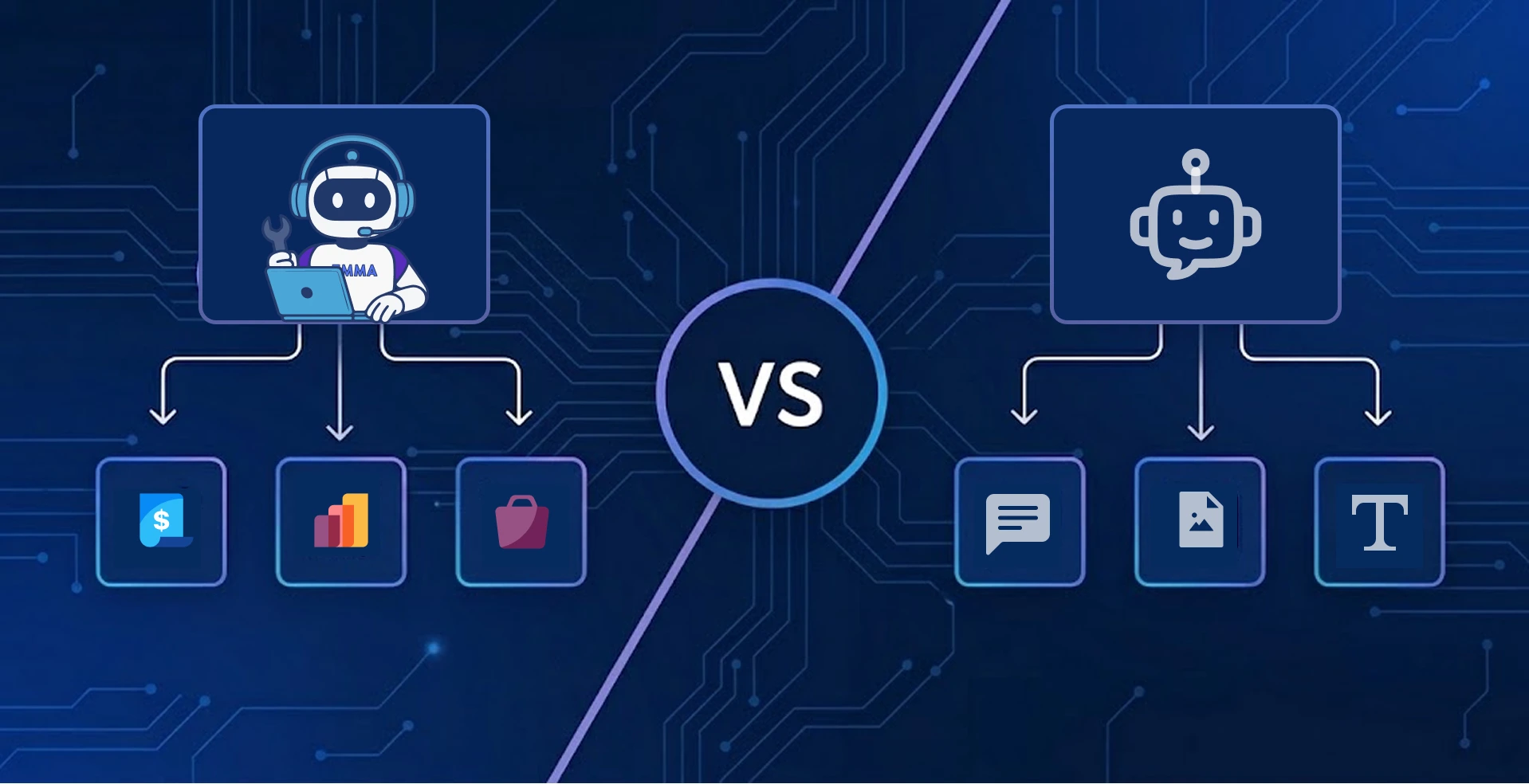
Generative AI and agentic AI aren't rivals. Agentic systems are built on generative models. The model is the reasoning engine. The difference is what surrounds it.
Generative AI |
Agentic AI |
|
|---|---|---|
| What you give it |
A prompt | A goal |
| What it returns |
Content: text, code, an image | An outcome: a record created, a task completed |
|
Who does the work
|
You, using its output | The system, with your approval |
|
Context |
Whatever you paste into the prompt | Live data it reads directly |
| Number of steps | One | As many as the goal needs |
|
When it's wrong
|
You spot it when you read it | It should detect it and stop |
|
Typical example
|
"Draft a reply to this customer" | "Resolve this customer's request" |
The one-line version: generative AI produces content; agentic AI produces results.
This also explains a frustration many teams recognise: Generative AI produced a real productivity gain on drafting and a real productivity loss on everything around it: copying data in, checking the output, pasting it back. The work moved; it didn't disappear. Agentic systems attack that surrounding work, not the drafting.
Generative AI produced a real productivity gain on drafting and a real productivity loss on everything around it.
03 Three operational examples
Abstract definitions age badly. Here's the same distinction across three routine operations.
1- A supplier invoice arrives:
Generative AI: you upload the PDF and ask it to extract the data. It returns a clean summary. You open the accounting system and type it in.
Agentic AI: the invoice arriving is the trigger. The agent reads it, identifies the supplier against your existing records, checks whether a purchase order matches, drafts the accounting entry with the right accounts and tax treatment, and flags the two amounts that don't reconcile. It stops there and asks you to approve.
What stays human: posting the entry. The agent prepares; a person confirms.
2- A qualified lead goes quiet:
Generative AI: you ask for a follow-up email. It writes a good one. You still have to remember which lead, what was said, and when.
Agentic AI: the silence itself is the trigger. The agent detects that a qualified opportunity hasn't moved in fourteen days, reads the full history (calls, emails, the quote that was sent) drafts a follow-up that references the actual objection raised on the last call, and schedules the next step in the pipeline.
What stays human: sending it. And deciding whether this deal is worth chasing at all.
3- Stock hits its reorder threshold:
Generative AI: you ask what you should reorder. It can only answer from what you tell it.
Agentic AI: it watches stock levels continuously, cross-checks open sales orders and supplier lead times, prepares the purchase order with the supplier who actually delivers on time for that reference, and warns you that a second reference will run out in eleven days if nothing is ordered.
What stays human: the purchase decision and the budget.
Notice the pattern across all three. The agent never removes the decision, it removes the twenty minutes of gathering that happen before the decision.
04 What agentic AI is not
The term is being applied to almost anything with a chat interface. Four things agentic AI is not:
- It is not a chatbot with a new label. A chatbot answers within a conversation. If the only thing it changes is what appears on screen, it's a chatbot — however good the answers are.
- It is not classic workflow automation. Rule-based tools execute a sequence you designed in advance: if this, then that. They're excellent when the process is stable and predictable. An agent decides the sequence at runtime, based on what it finds. Different tool, different problem — and rule-based automation is often the better answer.
- It is not autonomous AI running unsupervised. In a business context, an agent that executes without approval, without permission boundaries and without a log isn't advanced — it's a liability. Approval gates aren't a limitation of current systems; they're a design requirement.
- It is not artificial general intelligence. An agent that handles invoices doesn't understand accounting. It executes a bounded task well within a bounded domain. Outside that domain it fails, and it should fail visibly.
There's also a practical limit worth stating plainly: an agent is only as useful as the data it can reach. An agentic system connected to nothing is a chatbot with extra steps. This is why the connection layer matters as much as the model — the emerging standard for it is MCP, the Model Context Protocol.
05 What changes in business management software
For thirty years, business software has been built on the same assumption: the software holds the data and shows it on screen, and a person reads the screen, decides, and types the outcome back in. Every ERP, CRM and accounting package is a very refined version of that loop.
Agentic AI breaks the assumption. If a system can read the same records, evaluate them and prepare the outcome, then the screen stops being where work happens and becomes where work gets reviewed. The interface stops being the product.
That shift is already visible in small ways: the invoice that arrives already coded, the follow-up that's drafted before you remember the lead exists, the purchase order waiting for a yes. None of it is dramatic on its own. Together it changes what an employee's day is made of — less data entry, more judgment.
Two things do not change, and they're worth being honest about:
- Accountability doesn't move. If a wrong entry is posted, the responsibility is the company's, not the model's. That's exactly why approval and audit trails matter.
- Bad data stays bad. An agent reading a chaotic customer database produces confident nonsense faster than a person would. Agentic AI amplifies the quality of your data — in both directions.
For companies already running an ERP, the practical question isn't whether to replace the system. It's whether agents can reach the data inside it. That's what the MCP standard was designed for, and it's how external models like ChatGPT or Claude connect to your own records.
06
Frequently asked questions
Agentic AI is software that receives a goal instead of an instruction, plans the steps needed to reach it, uses real tools and data to execute them, and verifies its own results. The defining trait is that it acts rather than only answering.
Generative AI produces content; agentic AI produces outcomes. A generative model writes the email you asked for. An agentic system identifies which customer needs an email, writes it with the full history in context, and schedules the follow-up — leaving you the approval. Agentic systems are built on generative models: the difference is the tools, the data access and the feedback loop wrapped around them.
The realistic uses today are bounded, repetitive operations with a clear trigger and a verifiable outcome: processing incoming documents, reconciling payments, following up on stalled opportunities, answering support requests from your own records, and monitoring stock. What they share is that the data already exists in a system and the outcome can be checked. Open-ended strategic judgment is not one of them.
See agentic AI working on your own data
Agents that read your records, propose the next step, and act only with your approval. Inside your ERP. Free plan available, no credit card.
KEEP REEDING
Where agentic AI is already running

The ERP with built-in AI
See how agents sit natively inside the platform instead of being bolted on as add-ons.

Agents inside your Odoo
Already running Odoo? Add agents to the setup you have today, without migrating.
Automatic accounting in 2026
How AI is reshaping journal entries and day-to-day bookkeeping.
Empiece a escribir aquí...
Agentic AI: what it is and why it changes business software.