Subject: ERP Comparison
Read time: 8 minutes
Updated: May 2026 (pricing and features may change)
What's inside: Feature comparison table, pricing breakdown, which platform fits which business type
01 Intro
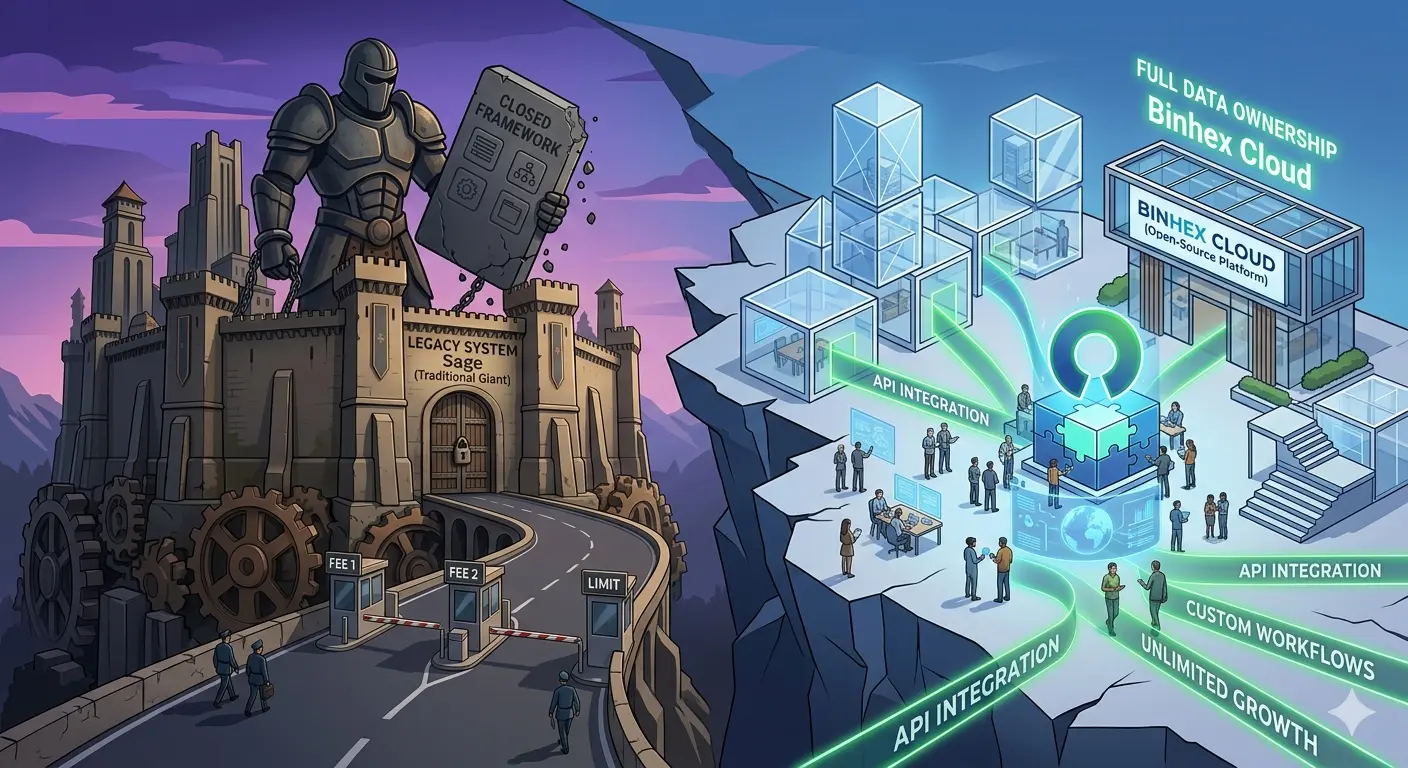
If you're comparing Binhex Cloud and Sage, you're looking at two different eras of business management. Sage is a titan in the Spanish market with 30 years of history, while Binhex Cloud represents the modern, open-source approach to ERP. The decision often comes down to a fundamental question: Do you want a traditional, standardized system or a flexible platform that scales without licensing friction?
Key differences we'll cover:
Ownership: Proprietary "Black Box" vs. Open-Source Freedom.
Pricing: Per-user/module licensing vs. Managed Service model.
Ecosystem: Rigid standard updates vs. Custom professional workflows.
02 Traditional Giant vs. Open-Source Platform
Binhex Cloud and Sage attract similar businesses: Growing companies tired of spreadsheets. But solve the problem differently:
Sage delivers a highly structured, reliable environment. It is the safe choice for companies that need a standard tool that "just works" and is widely known by Spanish accountants. It excels in stability and a massive partner network.
Binhex Cloud takes a platform-first approach. Instead of buying a finished product with locked doors, you get access to the full Odoo-based engine from day one. It’s designed for companies that find Sage's "add-on" pricing or closed ecosystem too restrictive for their specific digital transformation needs.
03 Binhex Cloud vs Sage: Side by Side
If you're evaluating both platforms, this table summarizes what matters. The first six rows are usually what decides the choice.
Binhex Workspace |
QuickBooks |
|
|---|---|---|
| Integrated CRM | Built in (Native) | ⚠️ Add-on required |
| Inventory management | Real-time, connected | ⚠️ Limited by plan tier |
| Sales pipeline and quoting | Pipeline to invoice | Included in standard plans |
| Real-time financial reporting | Live across all modules | Included (Standard fiscal engine) |
| Workflow automation | Built in | ⚠️ Limited/Requires API setups |
| AI assistant | Embedded in platform | Not included in core tiers |
| Operations and purchasing | Fully integrated | ⚠️ Tier-gated (Advanced MRP requires upgrade) |
| Per-user pricing | No per-user fees | Per user, per month |
| Open source / no lock-in | Full ownership | Closed platform |
As you can see, Sage wins on historical reliability and ease of finding trained staff. Binhex wins on long-term flexibility and removing the "pay-to-grow" tax.
04 True Cost Over Time: The "Module Tax" vs. Service Fee
How Sage solves pricing
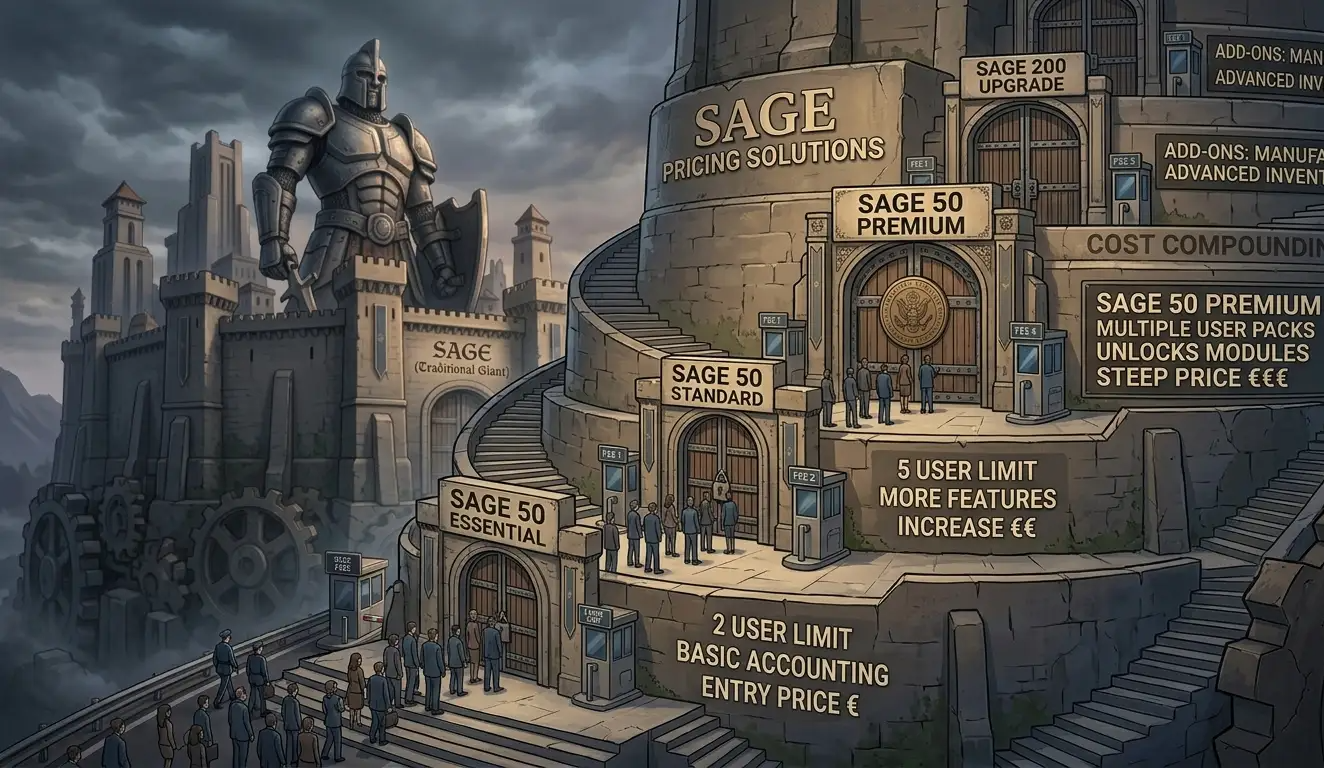
Sage typically operates on a tiered model (e.g., Sage 50 vs Sage 200). As you need more advanced features like production control, multi-warehouse management, or more users, you must upgrade your plan or purchase specific "Add-ons." This makes the entry price attractive but creates a "staircase" of increasing costs as you grow.
Binhex Cloud Pricing
Binhex Cloud flips the model: €0 for software licenses (all modules unlocked), and you pay for hosting and managed services—typically €300-400/month for a comparable setup, including technical support and infrastructure.
The difference? Your costs don't multiply with each new module or user tier.
Year 1 might feel similar, but by year 3-5, the open-source model typically saves 30-50%.
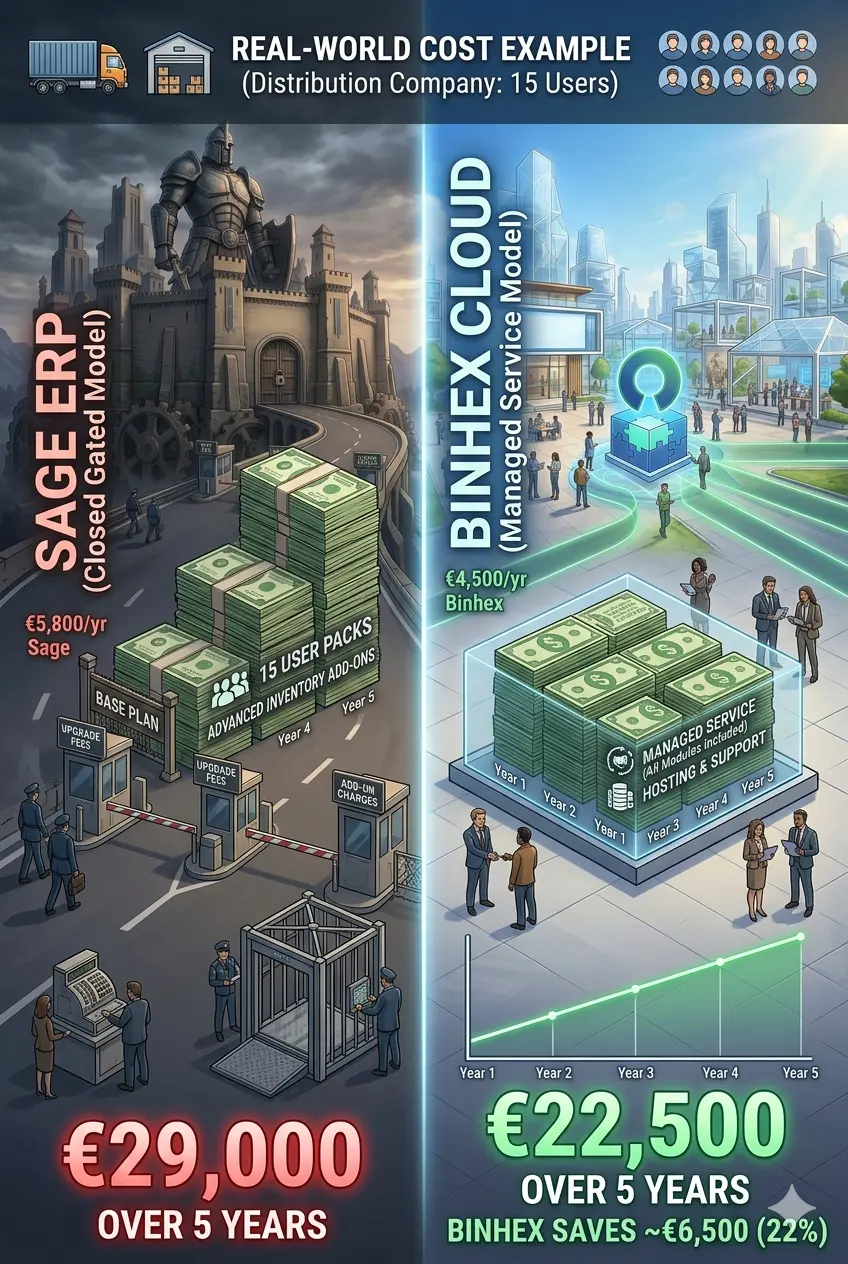
Real example: Distribution company, 15 users, needs Advanced Inventory + CRM + Financials.
- Sage: Base plan + User packs + Inventory Add-ons = ~€5,800/year → €29,000 over 5 years.
- Binhex Cloud: Managed Service (All modules) = ~€4,500/year → €22,500 over 5 years.
(Estimated costs based on standard mid-market implementations).
05 Scalability: Breaking the Gated Feature Model
In traditional systems like Sage, "Enterprise" features are reserved for "Enterprise" prices. This creates a ceiling for growing SMEs. Learn more about how feature gating impacts growing businesses.
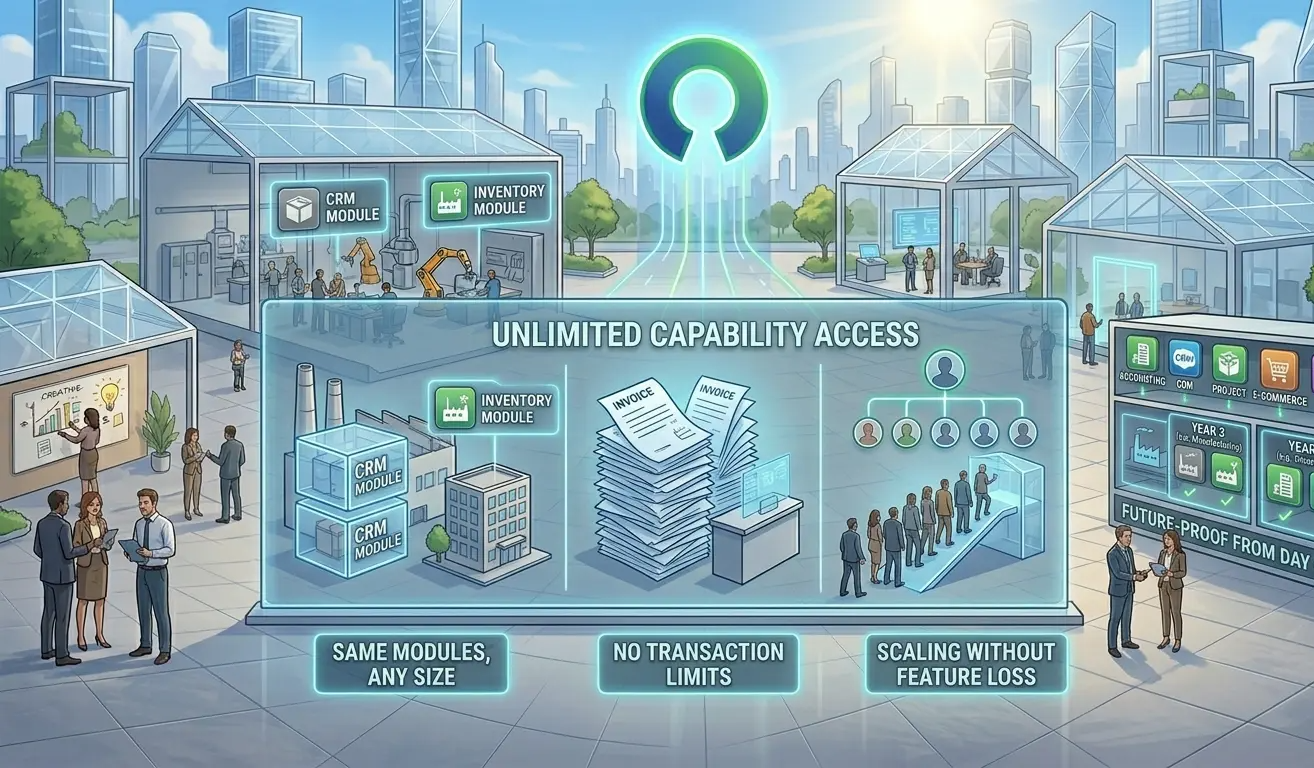
What unlimited capability access means in practice:
Same modules, any size: A 5-person startup and a 50-person manufacturer use identical CRM, inventory, and manufacturing modules.
No artificial transaction limits: Sage caps invoices per year by plan (500, 1,000, 3,000). We don't.
Add users without feature loss: Scaling from 8 to 25 employees doesn't trigger a forced migration to a different product tier or feature set.
Future-proof from day one: Need manufacturing capabilities in year 3? They're already there. Explore our full module library to see what's available.
06 Vendor Lock-in vs. Data Ownership
Here's the question nobody asks during demos but everyone wishes they had: what if you need to switch providers in 2-3 years?
The lock
Sage and most SaaS platforms are proprietary. You can export data (CSV, PDF), but your system configurations, customizations, and workflows stay with them. Switching means rebuilding everything from scratch.
Full Source Control
Binhex Cloud runs GPL-licensed open-source software. You own the code, you own the data, you own the configurations. Unhappy with us? Download your database and move to any other Odoo provider, or run it yourself.
Proven Portability
We've helped clients migrate away when another provider was a better fit. That optionality isn't theoretical, it keeps everyone honest. Your business should never be held hostage by your software vendor.
07 Which Platform Matches Your Situation?
The best choice depends on your current context and where your company is going. Here's the framework based on real implementations:
Choose Binhex Cloud when:
You're planning for 10-100 employees within 3-5 years
Predictable long-term costs matter more than low entry price
You want full ERP capabilities without feature paywalls
Data ownership and system flexibility are non-negotiable
You're willing to invest setup time for long-term scalability
Choose Sage if:
You don't need manufacturing, warehousing, or ecommerce
You're comfortable with feature upgrades costing more monthly
Your workflows are standard and don't require customization
Accounting software built on an open source ERP, backed by experts
Binhex has implemented accounting systems for 15+ years. We understand finance operations and we deliver long-term.
" We switched from three different tools to one. The time we save every month is worth it alone "
Questions you're probably asking
Yes. We extract your data (Sage allows CSV/Excel exports), map it to Odoo's structure, and import customers, products, invoices, and inventory. Typical migration takes 2-4 weeks with parallel systems during transition. Most teams are fully operational within a month.
Public pricing for Sage 50 (verified May 2026) lists base plans between €45 and €152/month (excluding VAT, under annual contracts). However, these entry rates are tightly linked to user limits and feature tiers.
The Essential tier (€45/month) is restricted to a maximum of 2 users and basic accounting, while the Standard plan scales to €102/month for up to 5 users. For a growing 10-person company requiring full multi-user collaboration and complete functionality, you are automatically pushed to the Premium tier starting at €152/month (~€1,824/year) as a base framework.
Yes and no. Sage's interface is more polished and simpler—because it has fewer features. Odoo has a steeper learning curve, but "complicated" often means "more capable." We offset this with onboarding, AI-guided setup (launched 2025), and documentation. Most teams are productive in 1-2 weeks. The question is whether your business needs that extra power.
Completely. We support SII, TicketBAI, Batuz, and Verifactu through OCA-certified modules. Many of our clients are Spanish SMEs managing Hacienda reporting directly from the system.
You can, but switching costs increase over time—more data, more integrated workflows, more muscle memory. If you anticipate needing advanced features (manufacturing, multi-location, custom workflows) within 18-24 months, starting with a platform that won't require migration saves disruption and cost.
Yes. We offer fully functional sandbox environments loaded with realistic data so your team can test actual daily operations and workflows, rather than just clicking through a generic tour.
Unlike traditional proprietary trials—which are frequently limited to a single user or restrict you to a tiny sandbox volume (such as a maximum of 50 invoices or limited ledger entries)—our test environments include unrestricted access to the full module ecosystem. When you test a process in a Binhex trial, you are interacting with the exact, unconstrained architecture your business will use in production.

Not Sure Which Direction Fits Your Business?
We've worked with dozens of companies switching from Sage, and we've also told prospects when Sage was genuinely a better fit for their situation. We'd rather have an honest conversation than sell you the wrong solution.
Binhex Cloud vs Sage: Complete ERP Comparison 2026