Why did we choose an external approach to facilitate AI solutions for Odoo?
Odoo is known for its ability to integrate a wide range of business processes in one place, from sales and accounting to inventory management and CRM. This versatility is one of its greatest strengths, but it can also be a limitation. For example, in the e-commerce sector, Odoo cannot compete with specialized platforms like Shopify or Magento, which are optimized to offer advanced and specific functionalities for online stores.
The same applies when we talk about artificial intelligence (AI). While Odoo allows the integration of AI solutions within its ecosystem, it is not specifically designed to be an advanced AI system, as would be dedicated external frameworks like TensorFlow o OpenAIThese frameworks specialize in offering much more powerful and efficient machine learning and natural language processing solutions.
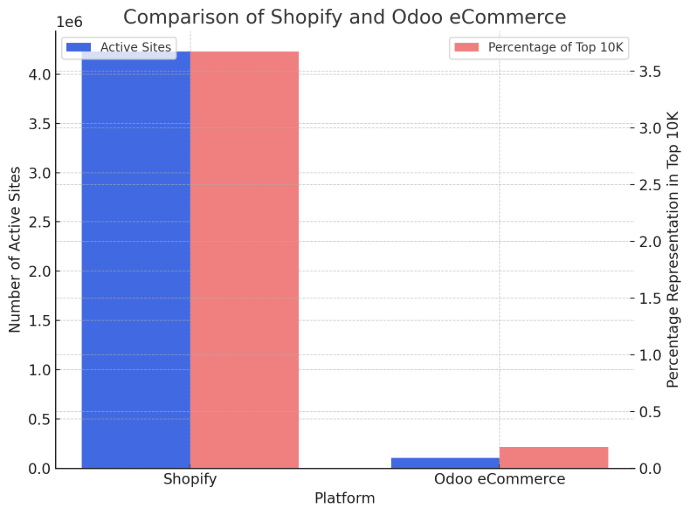
Strengths and weaknesses of Odoo in AI integration:
As with e-commerce, when it comes to integrating AI into Odoo, in-house solutions can't always compete with leading specialized platforms. However, instead of relying solely on Odoo's internal capabilities, our strategy has been to integrate external AI frameworks via APIs. This integration allows us to leverage the latest AI advancements while maintaining a seamless user experience within Odoo, offering a unified interface. This also opens the door to connecting Odoo with external platforms such as Store, Hubspot, Salesforceand many more, without losing the centralization and efficiency of an ERP.
With this approach, we not only advance with cutting-edge technologies, but we also align our product with the new paradigm shift in ERP systems, where specialized tools are integrated without compromising the user experience.
Discover how our artificial intelligence can transform your processes in Odoo!

Comparison: AI framework for Odoo vs. an external (open source) framework
Next, we analyze the main differences between developing an AI framework for Odoo from scratch or using an external open-source framework, based on several key aspects.
| Appearance | Develop an AI framework for Odoo | Use an external (open source) framework |
|---|---|---|
| Development and maintenance | You'll need a specialized team to develop and maintain the system. The effort is considerable, especially with Odoo updates. | Using an existing framework reduces development and maintenance effort, but it may be necessary to adapt it to your specific needs. |
| Community and support | The Odoo community is likely smaller when it comes to artificial intelligence, which limits sources of external support. | Open source frameworks typically have active communities that offer support, updates, and continuous improvements, making it easier to resolve problems. |
| Integration with Odoo | Full and native integration with Odoo. Take advantage of all system functionalities and data consistency. | Integration with Odoo may require customization and additional work, as not all open-source frameworks are specifically designed for Odoo. |
| Flexibility and customization | Total flexibility to adjust the framework to the specific needs of your business and adapt it comprehensively. | Some open-source frameworks allow customization, but they are generally more focused on general use cases, which limits advanced modifications. |
| Adoption and usability | Rapid adoption can be difficult due to the need for training and familiarization with a new system. | External frameworks typically have a broader user base and documentation that facilitates rapid adoption and training. |
Conclusion:
The decision to develop a custom AI framework for Odoo or use an external one depends primarily on the tools you already use. For example, if you already use platforms like HubSpot and want to integrate them with Odoo, choosing an external AI framework will allow you to use both platforms without losing the ability to work from a single interface. This eliminates the need to switch between tools, improving operational efficiency.
I believe the future of software solutions will move towards a single interface, with AI agents managing connections between different platforms. Integrating AI directly into Odoo could limit this paradigm shift, as it doesn't allow the necessary flexibility to connect with other specialized solutions. Therefore, we decided to connect to an external framework, which allows us to continue adapting to the best available tools while maintaining a unified user experience.
Internal or external framework? The key decision for integrating AI into Odoo