Shopify Ecommerce: Is it the best solution for your business?
The current e-commerce market is a highly competitive and constantly evolving environment. The pandemic dramatically accelerated the shift of shopping to the digital realm, and today, businesses of all sizes recognize the importance of having a strong online presence.
This boom has led to a wide range of platforms. E-commerceEach has its own advantages. Among the most popular are Shopify, known for its ease of use and wide variety of templates; Magento, ideal for large companies that require a high level of customization and scalability; PrestaShop, a flexible and open-source option, very popular among small and medium-sized businesses; and WooCommerce, a WordPress plugin that offers easy integration with other WordPress tools.
Shopify vs Odoo: Detailed Comparison for 2024
Odoo vs. Shopify, Magento, Prestashop, and WooCommerce
Choosing a platform for your online store can be overwhelming. The market offers a wide variety of options, each with its own features and advantages. In this comparison, we take an in-depth look at the five most popular e-commerce platforms: OdooMagento, ShopifyPrestaShop and WooCommerce.
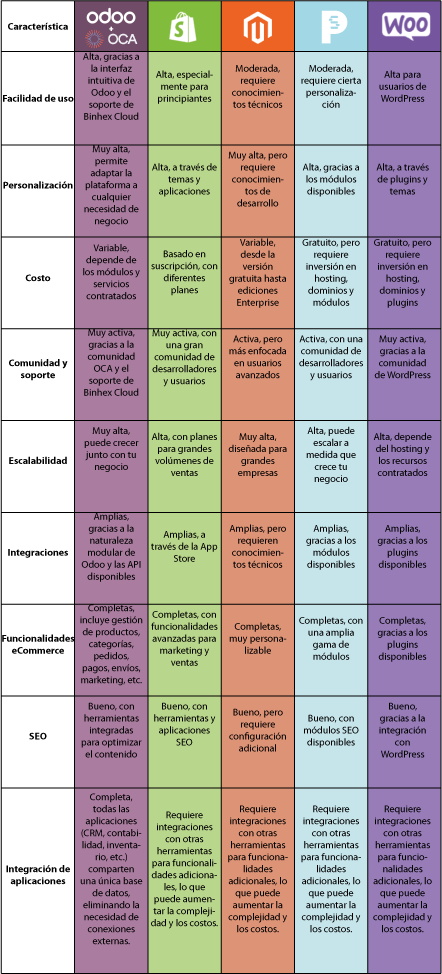
This table allows you to quickly and easily evaluate the strengths and weaknesses of each platform in key areas such as ease of use, customization, cost, community and support, scalability, integrations, and specific e-commerce features. This will enable you to make an informed decision and select the platform that best suits your business needs.
Feature | Odoo + Binhex Cloud | Shopify | Magento | PrestaShop | WooCommerce |
Ease of use | High quality, thanks to Odoo's intuitive interface and Binhex Cloud support | High, especially for beginners | Moderate, requires technical knowledge | Moderate, requires some customization | Registration for WordPress users |
Personalization | Very high, allowing the platform to adapt to any business need | Sign up, through themes and applications | Very high, but requires development knowledge | Stop, thanks to the available modules | Add, using plugins and themes |
Cost | Variable, depends on the modules and services contracted | Subscription-based, with different plans | Variable, from the free version to the Enterprise editions | Free, but requires investment in hosting, domains, and modules | Free, but requires investment in hosting, domains, and plugins |
Community and support | Very active, thanks to the OCA community and Binhex Cloud support | Very active, with a large community of developers and users | Active, but more focused on advanced users | Active, with a community of developers and users | Very active, thanks to the WordPress community |
Scalability | Very tall, it can grow with your business | High-end, with plans for high sales volumes | Very tall, designed for large companies | High price, scalable as your business grows | High, depends on the hosting and resources contracted |
Integrations | Extensive, thanks to Odoo's modular nature and available APIs | Expandable, via the App Store | Extensive, but requires technical knowledge | Larger, thanks to the available modules | Larger, thanks to available plugins |
E-Commerce Features | Complete, includes product management, categories, orders, payments, shipping, marketing, etc. | Complete, with advanced features for marketing and sales | Complete, highly customizable | Complete, with a wide range of modules | Complete, thanks to the available plugins |
SEO | Well, with built-in tools to optimize content | Well, with SEO tools and applications | Good, but it requires additional configuration | Well, with SEO modules available | Well, thanks to the integration with WordPress |
Application Integration | Complete; all applications (CRM, accounting, inventory, etc.) share a single database, eliminating the need for external connections. | Requires integrations with other tools to obtain additional functionalities, which can increase complexity and costs. | Requires integrations with other tools to obtain additional functionalities, which can increase complexity and costs. | Requires integrations with other tools to obtain additional functionalities, which can increase complexity and costs. | Requires integrations with other tools to obtain additional functionalities, which can increase complexity and costs. |
Choosing a platform for your online store can be overwhelming. The market offers a wide variety of options, each with its own features and advantages. In this comparison, we take an in-depth look at the five most popular e-commerce platforms: Odoo, Shopify, Magento, PrestaShop, and WooCommerce.
This table allows you to quickly and easily evaluate the strengths and weaknesses of each platform in key areas such as ease of use, customization, cost, community and support, scalability, integrations, and specific e-commerce features. This will enable you to make an informed decision and select the platform that best suits your business needs.
When comparing Shopify with Odoo, we must consider Odoo's flexibility versus Shopify's simplicity.
One of Odoo's greatest advantages is its unified approach. Unlike other platforms that require multiple applications and external connections, Odoo integrates all the tools needed to manage a business into a single database. This significantly simplifies processes, reduces maintenance costs, and minimizes the risk of errors.
By eliminating the need for multiple integration points, Odoo ensures greater efficiency and consistency in information management. Furthermore, thanks to the applications and add-ons provided by the Odoo Community Association (OCA), which provides nearly 2500 additional applications, allows companies to further customize and extend Odoo's functionalities to suit their specific needs.
Binhex Cloud: Odoo is much more than e-commerce
Binhex Cloud Binhex Cloud takes the Odoo experience to the next level. By combining the power of the most versatile ERP on the market with an active community like OCA, Binhex Cloud offers a comprehensive solution that goes beyond simple e-commerce.
Furthermore, this platform not only allows you to manage your online store efficiently, but also provides tools to optimize every aspect of your business, from customer and supplier management to accounting and production. With Binhex Cloud, Odoo becomes the core of your company, unifying all your processes and giving you a complete overview of your business.
Success story: C’est Pádel optimizes its operations with Binhex Cloud and Odoo
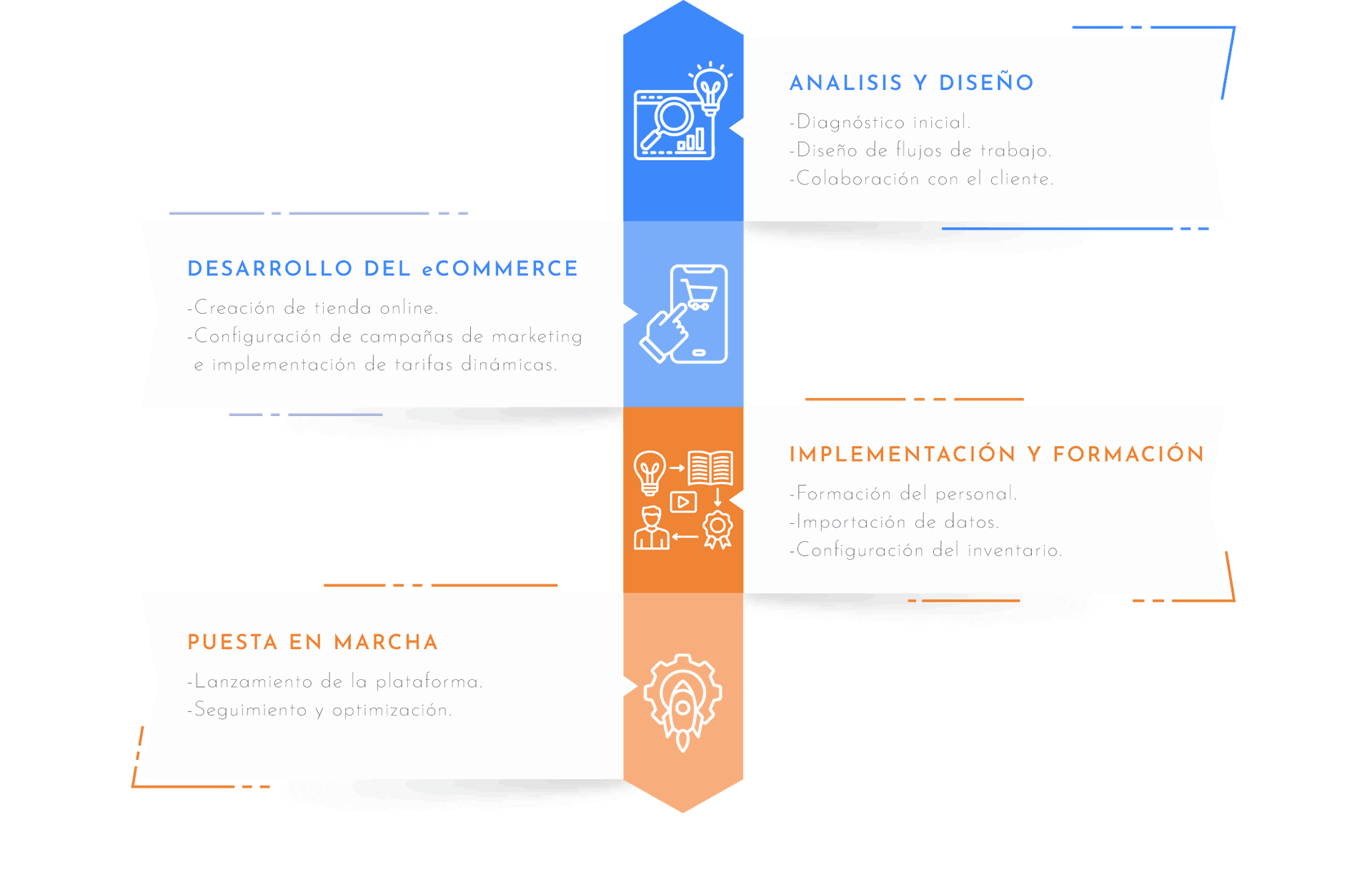
C’est PádelC’est Pádel, a leading padel club in the Canary Islands, was looking for a solution to unify its inventory management across its multiple sales channels. The need to efficiently connect its online store, physical point of sale, and distribution channels presented a challenge that directly impacted data accuracy and process optimization. By adopting Odoo, C’est Pádel centralized all its information, optimizing its purchasing strategies and achieving a higher profit margin.
Decision evaluation
The decision to implement Odoo as its e-commerce platform marked a turning point for C’est Pádel. Customization, scalability, and the integration of all sales channels have allowed the company to optimize its operations, improve the customer experience, and position itself as a leader in the padel sector. Choosing the right e-commerce platform has been fundamental to achieving this growth.
Odoo vs. Shopify, Magento, and WooCommerce: Which is the best option?